


Online retailers should pay a lot of attention to the product page, including the product texts. Here we explain what matters most.
Good product texts can boost sales
In many blog posts, we have already given tips and tricks for improving online shops. For example, we have already looked at the product detail page as a whole. One part of the product page is, of course, the product text, which we would like to take a closer look at today.
In many online shops, the product text is treated rather like a stepchild or completely neglected. Yet it is precisely through the texts that there is an opportunity to increase sales in the shop. There are even some dangers, for example when images and texts are taken over from the manufacturer without changes.
In that case, Google rates the shop as a copy of another, which leads to a poor ranking in the search. Furthermore, the ranking drops if the product texts are too short. Because then they have low relevance for the search engine and are not sufficiently considered.
Writing texts for the user
First-class texts should not only be written for the search engine. Ultimately, the customer decides whether to buy the item. If they find meaningful and appealing texts, this increases the likelihood of purchase. After all, the customer has a lot of questions about the product, which can be answered in advance in a good text.
If the buyer is sufficiently informed, they decide to make the purchase. If they receive the product that matches their expectations and the description, the return rate consequently also decreases.
Of course, with very many items in the online shop, it can be a Sisyphean task to optimize all products with texts and meta data for Google. But the work pays off in two respects.
On the one hand, the ranking improves, and on the other, the shop gains customer trust. First, you should concentrate on the most important products; the optimization can then also be done gradually.
Optimize meta data conscientiously
Meta data is an important tool of onpage optimization and influences the ranking in Google search. The title tag is of particular importance. It should be meaningful and contain the relevant keyword. To display the title fully on the Google search results page, it must not exceed a size of approximately 482 pixels.
The meta description, i.e. the short description displayed on the Google results page below the URL, is also limited in its length (approx. 928 pixels). The description does not influence the ranking, but it does influence the prospective buyer. Here they already receive the first most important information about the product they are looking for and are encouraged to click.
How good is good?
But what actually are good product texts? One thing is clear: simply listing the product features is not enough. Much more important is to reveal to the customer all relevant information about the product.
If they were able to get a sufficient overview, the trust of the page and the trust in the retailer as an expert increase in their eyes. In the text, the advantages that the customer has when buying in exactly this online shop should be highlighted.
If they also feel personally addressed, this increases the chance of a completed purchase. With a good and individual product text, you set yourself apart from the competition and increase visibility on Google.
With all the advantages that optimized product texts bring, the images should not be forgotten. Not just one photo of an item should be shown, but an image should be available from every perspective, perhaps even in a 3D view. Special features of the product should also be made visible. A high quality of the photos goes without saying.
Good product pages in the online shop convince customers
published on 14.09.2015
Convincing customers of the qualities and products of your own online shop seems to be a challenging task in times of overflowing competition in online retail. But with effort, skill, the right understanding of customers and a stable technology, the chances are very good of achieving reasonable sales with an online shop.
We have already addressed some points in previous blog posts. For example, the service offerings, i.e. various payment and delivery methods or communication with the customer, play a significant role. Of course, the technical performance of a shop, such as the page loading time, is also enormously important. Naturally, all information pages such as terms and conditions, imprint, data protection and right of withdrawal should always be up to date.
5 tips for product pages in the online shop
Perhaps the most interesting shop page for the visitor is the product page, which we would like to look at more closely in this blog post. Anyone who treats their item detail pages carelessly will soon get the bill for it. Because some points you should definitely pay attention to contribute to the purchase, or indeed non-purchase, of your product. After all, the product page has to deliver what the salesperson offers in the store – professional advice and comprehensive information.
Product pages can be designed so well that no questions remain open for the customer and they enthusiastically add the item to the shopping cart. You just have to imagine the processes you go through when you want to buy shoes in a store in the pedestrian zone. You can look at the shoe from all sides, can try it on and feel it. And if you are not entirely sure, the saleswoman brings you a shoe that perhaps better matches your expectations. Of course, you cannot touch or try on the product in the online shop. But that can also be simulated very well. The following points can help with this.
1. Product presentation
With appealing and detailed product images, a lot of important information can already be conveyed. Make sure that the customer can enlarge the image (for example with a mouseover effect). This way they can get an impression of the texture and surface. For this, a high resolution is required.
Also show the product from many different perspectives, so that the customer can see all sides. If the item is offered in several colors, images of the variants are of course also necessary. Particularly illustrative are photos that show the product in use. A dining table looks much more appealing when it is nicely set. And of course a beautiful dress looks better on a beautiful woman than on a hanger.
If you let your imagination run free, you can use these photos to address the customer emotionally too. Create positive feelings with your images, make the viewer smile, and they will feel comfortable in your online shop.
Videos and graphics. Videos can convey the properties of the product to the customer even better. Graphics, on the other hand, are ideal when it comes to precise dimensions.
2. Product description
The be-all and end-all of your product page is the detailed description. This does not mean the product details or the short presentation, which already inform about the most important data such as colors or dimensions in brief bullet points. The product description essentially replaces the saleswoman. If it is well written, the customer feels sufficiently informed and takes the risk of shopping for something they cannot touch.
But this should not be a license for endless texts. It is about precise information about the product, which is sufficient but not too rambling. Of course, and one cannot emphasize it often enough, creativity is required here.
Never resort to texts you have copied from another page. You should also fundamentally change the manufacturer's text. If you do not heed this, you will most likely create “duplicate content”. You should spare yourself the trouble that follows from this.
With the texts it is quite similar to the product photos. If they are originally written, address the customer emotionally and are optimized for your target group, they help you to set yourself apart from the competition and to stay in the customers' memory.
Of course, you should also pay attention to reader friendliness in your product texts. The font size must therefore be sufficiently large, the text structured by headings and paragraphs or loosened up with bullet points.
If there is further material for your products, for example assembly instructions or installation and washing instructions, these can represent informative added value. Offer this as useful PDFs.
3. Product comparison and accessories
Many customers use an online shop for extensive browsing. Basically just like the good old strolling through the shopping street. Once the consumer has decided on a store, they quickly find an item to their taste there. But they are not quite convinced yet. Isn't there an even better one?
So that your customers do not leave the online shop, you should display similar items on the product page. This way they can compare to their heart's content and in the end select exactly the product that pleases one hundred percent. This of course also reduces the return rate and the customer reviews turn out positive.
Just as helpful as the product comparisons is the display of compatible accessory items or complementary products. When done subtly, this is not intrusive advertising, but actual added value for the customer.
With the basic version of Shopware and additional plugins, you can individually decide which additional items should still be displayed to your customers.
4. Product rating
To give the customer the final incentive in the purchase decision, it is advisable to publish customer reviews. This way, customers can be convinced by the product.
You do not have to hide negative reviews. As long as these do not become too prevalent and you as the shop operator have always reacted appropriately, negative reviews appear more authentic than too many effusive praises.
By the way, buying fake reviews is an absolute no-go.
5. Product information
Additional information about the product increases the trust that the customer places in the shop. When is the expected delivery date? How many items are still available? Which shipping and payment methods does the customer have? These questions should be answered transparently for the user.
Perhaps you also offer online ordering and pickup in the store. You should communicate that too.
Last but not least, you should actively show the user, for example through a popup, that the desired product has also landed in the shopping cart. The customer can then decide there whether they want to continue shopping or go straight to checkout. In this window you can also nicely display products that would go with it once again.
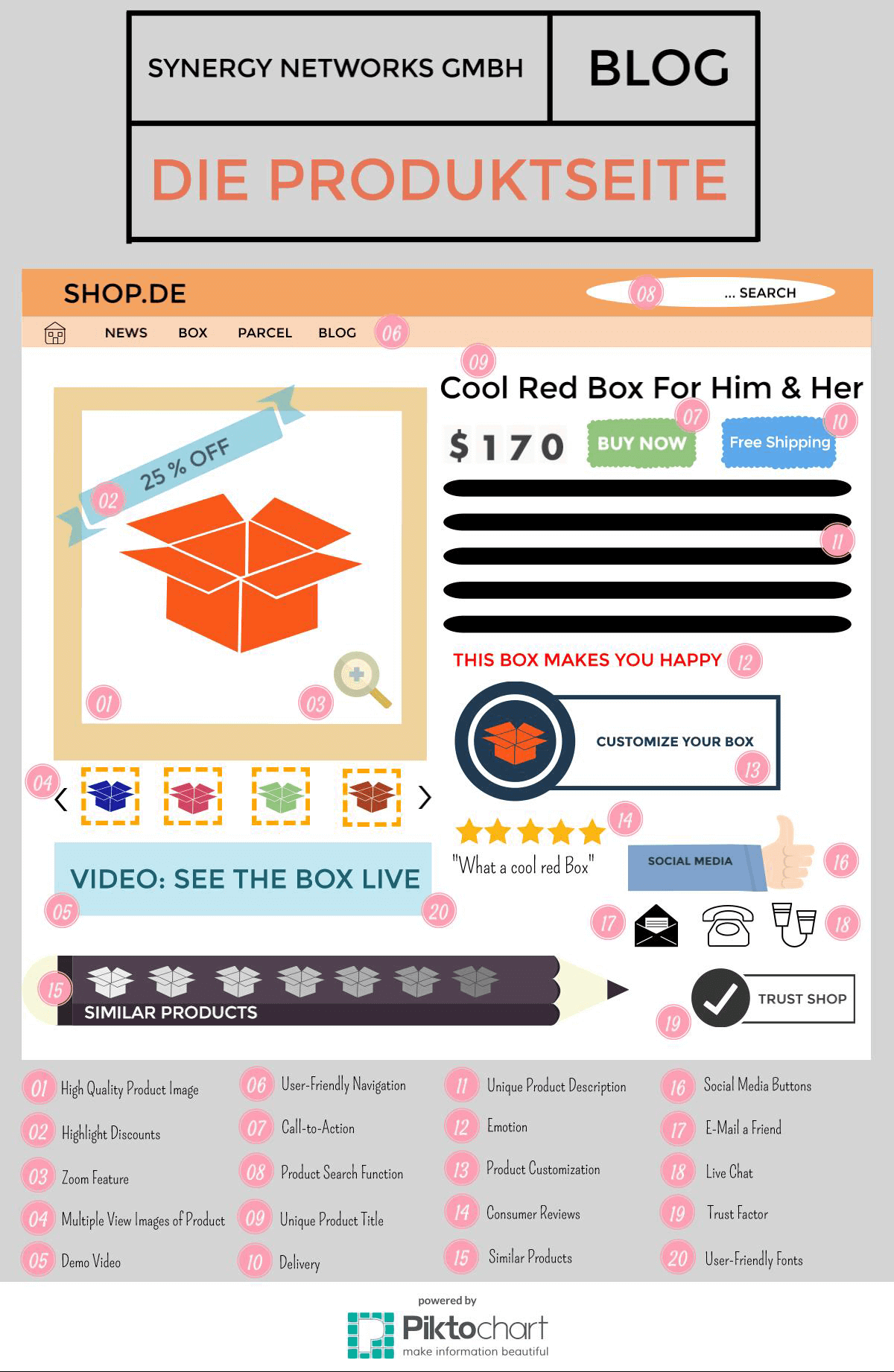
In our colorful infographic we have once again presented important points in a simplified way.
Comments
No comments yet.
Write a comment